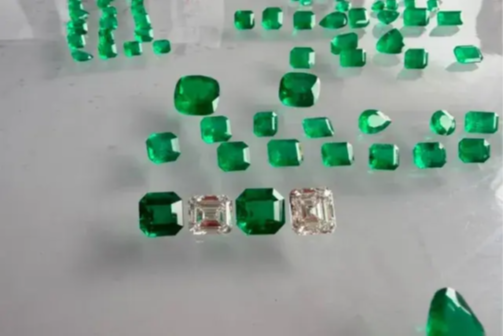
Experts explain the causes of the rise of this stone.
Colombian emeralds are replacing diamonds in luxury market segments such as engagement rings and high jewelry, a trend that has been strengthened in recent years by the growing search for natural stones, exclusive and with traceable origin.
While the global diamond market records an annual growth of 4.6%, that of emeralds advances at a projected rate of 6.1% according to Fortune Business, driven by the demand for highquality natural gems.
In fact, Colombia accounts for nearly 55% of the global market for these green gemstones, according to figures from ProColombia. María Inés Hincapié, CEO of Aria Gems and an emerald expert, attributes this shift to evolving preferences among luxury buyers, who now prioritize exclusivity and traceability.
“For years, the diamond was synonymous with commitment due to marketing, but today people seek pieces with their own identity, a history, and an origin they can know—and the Colombian emerald offers precisely that, since no two are alike,” she states.
Color is a primary factor driving this preference, as Colombian emeralds are recognized among the world’s most valuable for their intense, vivid, and balanced green hue, accompanied by a natural luminosity and brilliance that distinguish them from those of other deposits. These characteristics result from a unique geological formation process and a chemical composition that yields a purer tone—attributes highly prized by collectors, investors, and the fine jewelry industry.
With this gemstone, color carries more weight in valuation than size; consequently, a small, highly saturated emerald can be more valuable than a larger one with less intensity. Furthermore, high-quality Colombian emeralds are far rarer than commercial-grade diamonds, and finding a stone with pure color, good clarity, and an excellent cut poses a challenge even for specialists.
Added to this are the natural inclusions known as “gardens,” which act as the DNA of each emerald, as their composition and formation make it possible to identify the stone’s geological origin.
In the case of Colombian emeralds, three-phase inclusions (composed of liquid, gas, and a crystal) are a key distinguishing feature and a widely recognized indicator of provenance, making each gem a unique piece.
According to Aria Gems management, the fine jewelry market has shifted the criteria used to value these stones today, color, clarity, cut, and origin carry more weight than carat weight. Consequently, a small emerald with excellent characteristics can command a higher price than a larger one.
Furthermore, international certifications—such as those from the GIA (Gemological Institute of America) or IGI (International Gemological Institute)—along with the identification of specific mines like Muzo, Chivor, or Coscuez, add value by providing traceability regarding the gem’s origin.
Compounding this trend is the growing supply of lab-grown diamonds, which has diminished the perception of exclusivity surrounding these stones in the luxury market. In contrast, the limited availability of high-quality Colombian emeralds ensures their scarcity remains a key factor driving up their value and demand among collectors and investors. According to the CEO of Aria Gems, this distinction explains why an increasing number of buyers are prioritizing natural gemstones with certified provenance and characteristics that are impossible to replicate.